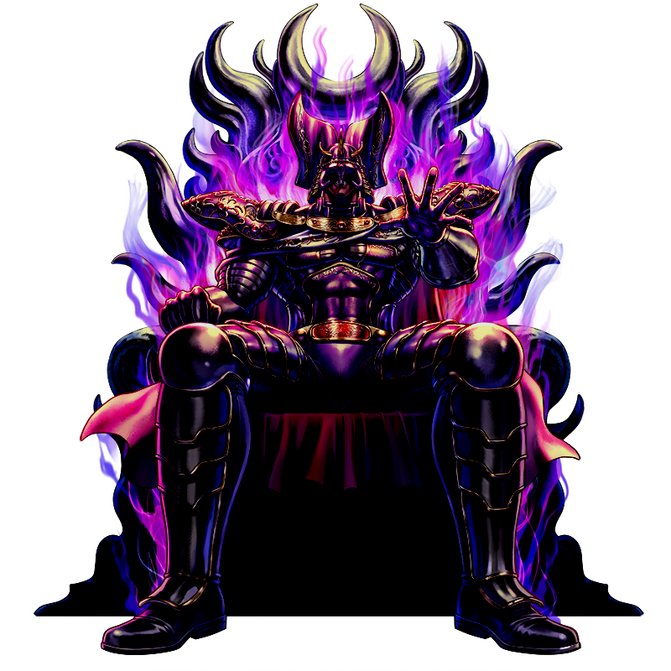
SUPREME DEMON LORD
BASIC INFORMATION
Name — Because the True Name of demons is a weakness that allows users of Blood Magic, including other demons, to bind the bearer of that name to their will, all demons adopt a new personal name when they rise to a station beyond that of mere footsoldiers. He chose the name Axiagor, meaning "Punisher of weakness" in the tongue of demons.Age — Demons are unaging, and can only be truly slain when they are destroyed on their home plane of Inferno. That terrible realm birthed him over 5,000 years ago.Race — While he is wholly demonic in nature, one demon will often differ completely in appearance to another. His human visage is nothing more than a diguise for his true form, a towering infernal dragon burning with an inner fire that burns the souls of the unworthy.Personality — Nothing good can be said of his personality, which aligns with all demonic values; this is to say that he cares nothing for others, and considers power to be the sole thing in this world worthy of his attention. He believes firmly that action is required to succeed, and that the weak are perpetually envious of the strong. Furthermore, this is the natural state of all things, and it is the right of the strong to oppress the weak. Nothing is sacred, and the only true evil is weakness. As such, he regards other living beings as nothing more than tools for his amusement, and his cruelty knows no bounds. All problems that can be solved with overwhelming violence will, and those that cannot will see all involved punished for this transgression.
HISTORY
Demons, although they are living beings (depending on one's definition of such a thing), are fundamentally not born. Axiagor came into existence 5,000 years ago, when the energies of the Inferno coalesced into an intelligent mind, and the ash perpetually blanketing the dark realm formed into a body to accompany that cruel intellect. Like all newborn demons, Axiagor was immediately enslaved by his superiors and put to work fighting the petty wars of the Inferno's lesser lords, a ceaseless string of bloody conflicts that saw millions of his kin perish every day.As fate decreed, or perhaps simply as luck would have it, he was among those demons who survived the brutal wars of the Inferno and painstakingly climbed the demonic hierarchy through a combination of trickery, ruthlessness, coercion, and brute force. After centuries of life, he was appointed general of one of Duke Belthazal's 22 legions, serving under him for another three centuries when, by chance, an opportunity to escape the Inferno presented itself. Such fluctuations in the barriers between planes were wholly unpredictable, and could be taken advantage of only if the demon in question was not too powerful, and therefore too tied to the fabric of the infernal plane, to be transported to the physical world through natural means.For the first time in his existence, Axiagor saw not the lakes of flame and ashen plains of his home realm, but the weak, fertile soil of Althea, the realm to which the Inferno was connected. It was from there that the souls of dead sinners fell into Inferno, and where they would be treated as slaves even lower than the weakest of demons. Fittingly for the abode of what he considered to be the lowest of the low, Althea was woefully unprepared for any infernal incursions that occurred in those ancient days. After subjugating his fellow escaped demons, he exterminated many of the locals living in the westernmost area of the continent, establishing what would in a later age be called the Demon Wastes. It was also during this time that the terrorized natives, knowing nothing of the true infernal hierarchy, came to call Axiagor the Demon Lord, for they knew him only as the most powerful demon their world had ever suffered the presence of, and therefore assumed him to be the ruler of all demonkind.Demon Lord Axiagor reigned uncontested in the west for over 200 years, cutting a blood swathe across all of Althea and bringing the lives of countless mortals to a painful end. It was only when the mortal races were on the brink of extinction that the gods of Althea, who usually did not interfere with earthly matters directly, revealed to their loyal followers a ritual for summoning a Chosen Hero from another world to contest the Demon Lord, bestowing on them great powers to match the otherworldly threat that Axiagor posed.When they met on the field of battle, the Demon Lord dueled the Hero of Althea for a day and a night, striking a fatal blow — but in their last moments, the fallen Hero called upon the greatest magic he was gifted, using the last of their lifeforce to seal Axiagor away.This cycle continued for thousands of years. Every time the seals eroded, a divinely-appointed Hero was summoned to defend the mortal realm from his predations. While Axiagor's strength was bolstered with every escape from the seals, and the the circumstances always differed, the cycle seemed fated to end with much of the world destroyed, the Hero slain, and the Demon Lord sealed by the power of the gods. After his escape from the third of such seals, he plundered the archives of countless mortal mages, seeking a way to empower himself after the Hero had been summoned to tip the balance in his favour; eventually, he learned of a great ritual known as the Well of Misery, a work of necromantic magic capable of making one equal to the gods. He searched relentlessly for its power, but it was said to be sealed away in the place of the Demon Lord's bane, and so it was beyond his reach. He narrowly defeated the Hero for the fourth time, and was sealed once more. It seemed to him that this divine farce would last for all eternity.That was, until the coming of the Hero who defied the cycle. Apparently summoned far ahead of schedule as some sort of political play by a human kingdom, the Hero had abandoned their duty and grown far more powerful than any of their predecessors, wielding Althea's magic and using their natural talent to conquer countless lands. When Axiagor marched on the mortal kingdoms once again, he found one who was not a demon, and yet capable of exceeding his raw might for the first time in his life — indeed, they had claimed the power of the Well of Misery for themselves, finding the specifics of the ritual after destroying the blade of the Chosen Hero. After a battle which reshaped the very land they fought in, a spell was woven to discern his True Name and bind him to the former Hero's will. After millennia of struggle, Demon Lord Axiagor had been decisively defeated.Rather than destroy the Demon Lord, the former Hero considered it more fitting that Althea's ancient foe would serve it as a general of the new order. Although he is kept away from the Emperor's other servants due to his problematic personality, the magic binding him ensures that he is wholly incapable of defying his master. But for all his bloodlust, Axiagor is nothing if not patient in the face of what others would consider a hopeless situation, and he has escaped the chains binding him once before...
ABILITIES
THE FORM OF THE DEMONIC
Demons are a form of life birthed by the hellish energies of Inferno. In this sense, they could be said to be similar to the creatures of the elemental planes, embodying malice as a phoenix embodies flame and a sylph embodies air. They do not require sustenance or rest in the way that ordinary beings do, and while some scholars claim that they are nourished by acts of evil, they perform these acts for nothing more than personal satisfaction.From birth, demons are more physically powerful than mortal races, and their magical strength is also far beyond the norm of Althea's inhabitants. Their most unusual trait is their immortality — should they die in any place that is not on their home plane, the infernal energies that make up their being return to the Inferno, where they are promptly reborn.
THE TOMES OF MAGIC
In Althea, magic is a natural force harnessed by those with the required talent and a great deal of experience studying its secrets. Though magical energy could theoretically be shaped into any form, the nature of the elements and spellcasting itself makes the division of magic into tomes and spells more effective than using it in its pure form.Ordinarily, mages obtain the magical energy needed to cast anything but the most minor spells by absorbing the power of naturally-occurring gems associated with their chosen tome, or by channeling the blood of slain sacrifices in the case of the tome of blood.
Magic is divided into eight tomes, which are grouped as such:The Four Elemental Tomes
— Urax, Tome of Fire
— Velthis, Tome of Water
— Beltham, Tome of Air
— Arzok, Tome of Earth
— Ilnir, Tome of NatureAs the name implies, the elemental tomes focus on manipulating the eponymous elements which make up the world. Many elemental spells have equivalents in other elemental tomes, and general uses are summoning, controlling, and expelling the element. Elemental mages can attack from afar with their element in a variety of shapes, form magical shields from it, create elemental shackles around an enemy to bind them, enchant themselves to resist their chosen element and its opposite, or summon elemental beings. The most powerful mages can kill enemies in an instant by summon the element inside their bodies, banish them to an elemental plane, all of which are completely hostile to non-elemental life, or summon the gods of these planes to fight on their behalf. Axiagor is a master of the most direct and destructive uses of Urax. His infernal origins preclude him from working with other elements.The Three Sacred Tomes
— Zemkar, Tome of Stars
— Orthos, Tome of Dreams
— Eledea, Tome of ZealWhile not all cultures on Althea consider the tomes of Zemkar, Orthos, and Eledea sacred, they are traditionally practiced by wise sages and holy men or women. Due to his demonic nature, Axiagor shuns these tomes and is incapable of using them.The Two Forbidden Tomes
— Krodir, Tome of Death
— Ralgos, Tome of BloodThe tomes of death and blood are practiced only by inhuman beings and pariahs living outside the bounds of civilization. In the history of Althea, the greatest threats to mankind's survival have often come in the form of practitioners of the forbidden tomes going mad with power and gaining enough of it to march on the human kingdoms. Krodir manipulates the energies of death, darkness, suffering, and the general negativity that is exuded by all of these things. Death mages are often necromancers, raising corpses in various forms and summoning spirits of the dead from the underworld as servants, but many are also capable of inflicting supernatural fear or disease upon enemies, draining them of their lifeforce, making their living bodies age or decay in the span of moments, and most infamously causing instant death with a single finger. Their powers over darkness extend to creating servitors from pure shadow and plunging entire kingdoms into impenetrable darkness. They are also capable of using negative energy to attack the souls of targets, though their methods are more brutish than the subtle if incredibly deadly workings of astral mages. Those skilled in the art of necromancy can forcefully take control of undead beings they themselves did not raise or undo the magic that gave them their unlife, causing them to crumble to dust. It was studied extensively by Axiagor in his search for greater power during his battles with the Chosen Heroes.The Tome of Blood was created by demons, and while Ralgos has no direct connection to negative energies, its spells can only be cast when channeling the power living in the spilt blood of the innocent. For this reason, demon warhosts are often accompanied by vast amounts of blood slaves to be sacrificed at their convenience. Its effects vary greatly, but many spells empower and heal the caster in the form of strengthening their magic or restoring their energy in exchange for the life of another living being. Offensive functions include inflicting unbearable pain on enemies, causing them to bleed profusely from all orifices, transferring the caster's own pain and wounds to them, binding their soul to the mage's service, or simply causing their body to shut down completely by tying the life of one of their sacrifices to that of their enemy's. The tome's strong connection to demonkind is both one of the greatest strengths and weaknesses of demons, since it is capable of forcefully binding the wills of demons to the caster's own and enslaving them. Mighty demons make use of this to ensure full control over their underlings, but many of them have themselves been bound to powerful human mages in the past. Axiagor is one of the demons responsible for introducing this tome to the mortal races, and his mastery of it is second only to the Lord of Domination.
SPELLS
The number preceding the name of the spell is its grade, a general assessment by mages of the spell's complexity. It is not strictly equivalent to its power, as a mage could for example channel an immense amount of energy into a first-grade spell to overpower a third-grade one. It is exceedingly rare for human mages who have not unnaturally expanded their lifespan to master spells above the third grade, and even long-lived magical beings such as elves are rarely capable of comprehending more than one sixth-grade spell. Spells above the sixth grade were reconstructed by the Lord of Domination from records of divine acts or otherwise personally invented through sheer magical aptitude, and taught to the Demon Lord.Urax, Tome of FireI — Burn: The targeted enemy is set ablaze. The spell ignores enemy armor, but it is not always strong enough to kill the victim. Also, rain or snow will put the flames out very quickly.I — Resist Cold: This spell makes targets resistant to cold. It also negates the chilling effect caused by some undead beings.I — Combustion: A group of targets are instantly set ablaze. The spell ignores enemy armor, and can be cast from any distance, but it is not always strong enough to kill the victim. Also, rain or snow will put the flames out very quickly.I — Blindness: A very bright light flashes in the target's eyes. The target will be permanently blinded unless the spell is resisted.I — Burning Hands: Flames will issue forth from the mage's hands, killing anyone in front of him.I — Protection from Fire: This spell protects the caster from fire and flames.I — Fire Shield: A wall of fire surrounds the mage. Anyone trying to strike the mage in melee combat will be burned by the fiery shield first.I — Bonds of Fire: Shackles of fire will trap the victim of this spell. If the victim tries to escape, the shackles become exceedingly hot. Otherwise, the heat stays bearable. A great amount of willpower is required to fight the heat and escape. Trying to escape may very well kill a weaker man.II — Transmute Fire: The alchemist transmutes fire gems into gold. Every gem spent gives the alchemist several pounds of gold.II — Immolation: The caster bursts into white-hot flames, badly burning everyone within range. Armor offers little protection against the flames. The spell will consume the caster if he is unprotected.II — Conflagration: Many enemies are instantly set ablaze. The spell ignores enemy armor, but it is not always strong enough to kill the victims. Also, rain or snow will put the flames out very quickly.II — Fire Blast: A powerful blast of fiery energies strikes a small area close to the caster.II — Fireball: The hallmark of Fire magic, this spell allows the mage to throw a ball of flame toward his enemies. The ball is quite difficult to aim, but does considerable damage wherever it lands.II — Pillar of Fire: This spell creates a huge column of fire that strikes from the sky. It will kill those who are hit and set fire to anyone who is standing nearby.II — Ignite Arrows: The mage enchants the projectiles of his arrows with magical flame. The projectiles burst into flame as they are fired, doing considerable damage to their targets. The fire damage of the arrow is magic and will affect ethereal and invulnerable creatures even if the projectile itself cannot.II — Flame Ward: This spell protects targets from fire and flames.II — Battle Fury: The caster fills the hearts of men with righteous fury. All targets gain greater willpower and strength.II — Rage: The spell fills the hearts of men with furious anger. The raging target will attack anything nearby, even friends.III — Incinerate: A single target is consumed by flames from the inside. Armor does not protect against this spell. It can target victims over long distances and it is one of the very few Fire spells that can be used underwater.III — Flare: The mage sends a gigantic ball of pure flame towards his enemies, which explodes upon contact.III — Falling Fires: This spell calls down a rain of searing flames on the enemy. The spell can strike from great distances, but takes longer time to cast than most other evocations.IV — Fate of Oedipus: The caster punishes an enemy for observing them with clairvoyance. The target's eyes are blasted by brilliance, their eye sockets emptied forever, and their claivoyant powers are greatly weakened.IV — Dome of Flaming Death: An invisible web of Fire magic is created over a kingdom-sized area where this spell is cast. Any enemy spells cast into the protected province will trigger the deadly trap. A powerful blast of fire will find its way to the casting mage and burn him and anything around him to cinders. The dome does not directly stop spells that pass through it, but it may stop the offending mage from ever casting spells again.IV — Raging Hearts: Fury will start to grow in the hearts of all people in a kingdom-sized area. Those affected will soon start to plunder and kill their fellow man.IV — Flameflesh Army: This spell transforms targets into red-hued apparitions. They become hot to the touch and highly resistant to cold. The transformation also protects from the chilling effects of some creatures, such as Wights and Winter Wolves.IV — Heat from Hell: A large area is struck by heat worse than that of the hottest of deserts. This heat soon renders all enemies nearby unconscious, after which death is certain. This spell is most effective in warm climates.V — Flames from the Sky: With this spell, the mage hurls a maelstrom of flaming spheres towards any location on the planet. The flame storm will strike with enormous force, capable of devastating an entire kingdom. Most likely, the majority of the enemies present will die from this powerful attack, but those highly resistant to fire or extremely durable have a chance of surviving. Through this spell, the fire mage will also be able to see exactly what is happening as the flaming spheres strike the enemy.V — All-consuming Pyre: The caster erupts in a pyre of white-hot flames, incinerating everyone and everything in a large area around him. Armor offers little protection against the flames. The spell will consume the caster if he is unprotected.V — Fire Storm: A massive storm of fire is unleashed on a large area. Everything within the vicinity will be burned to cinders within minutes. The flame storm will also shroud the area in blinding brightness, reducing the effect of night and certain spells. This spell is extremely powerful and can annihilate entire armies.
Krodir, Tome of DeathI — Animate Dead: The necromancer animates a lifeless corpse to unholy service.I — Hand of Dust: The caster's left hand becomes deadly, able to turn anything it touches to ashes.I — Skeletal Body: The body of the caster dries up and becomes impossibly thin and skeletal. Piercing weapons hitting the caster will cause less damage.I — Weakness: The mage damages the lifeforce of the target, making them permanently weaker.I — Ghost Grip: The caster summons energies from beyond the grave to target their enemies, exhausting them and draining them of life.I — Dust to Dust: The mage destroys undead beings by unraveling the magic that holds them together.I — Frighten: The spell fills the target with fear.II — Bolt of Unlife: This bolt passes straight through armor and bone and damages the target's soul directly. If the target is slain he will be filled by the energies from this spell and rise as a soulless warrior.II — Disintegrate: The necromancer points a bony finger at a target, who instantly turns to dust.II — Hand of Death: The left hand of the caster becomes deadly and forces death upon anything it touches.II — Shadow Blast: The necromancer hurls a blast of dark energies against his enemies. The blast ignores all armor and can paralyze those wounded by the spell. The undead are immune to this spell.III — Arouse Hunger: The necromancer curses targets with undeath. The victims will become ghouls that serve the necromancer.III — Carrion Reanimation: During a dark and stormy night, the unburied dead stir as the necromancer unleashes the vast powers of his art. Entire battlefields will be reanimated as soulless undead.III — Leeching Darkness: A deadly cloud of darkness will form and cover a large area. Anyone standing within the cloud will be wounded and permanently weakened.III — Soul Vortex: Anyone close to the necromancer will have his lifeforce drained from him. The lifeforce will be used by the necromancer to heal his wounds and restore magical energy.III — Terror: A connection is created between living enemies and the dead harrowed in the Netherworld. The targets are overwhelmed by fear and despair.IV — Darkness: A large area is covered in a blanket of darkness that renders even fire useless. Most ordinary beings will stumble and have great difficulty fighting or eveb moving in the darkness.IV — Drain Life: The caster drains lifeforce from the target and rapidly ages them into bones and then dust, adding the lifespan they stole to their own.IV — Plague: With this spell, the mage will bring a magic plague upon a large area. The magic plague kills and spreads at an enormous rate. It does not take long to catch the disease, nor does it take long to die once infected.IV — Rigor Mortis: The necromancer causes the joints of enemies to stiffen as their bodies suffer the fate of the newly dead. There is no immediate cure for the spell, but it subsides after some time unless it is reapplied.IV — Ritual of Rebirth: The caster of this spell revives a previously slain target via the ancient Ritual of Rebirth. The ritual mummifies the dead target before bringing them back to life.
Ralgos, Tome of BloodI — Bleed: The Bleed spell causes blood to pour out of the victim's nose, ears and mouth. The effect is a prolonged and painful death.I — Harm: This spell causes severe damage to the victims' chests and stomachs. The unfortunate victims will start to cough up blood and will most likely never fully recover from the harm done to them.I — Leech: The mage drains the lifeforce of their enemies. The lifeforce drained will be used to heal and reinvigorate the mage.I — Blood Heal: The mage spills the blood of a blood slave and is healed in return.I — Reinvigoration: By sacrificing a blood slave, the mage will remove all of his fatigue.I — Rejuvenate: The mage drenches himself in the blood of ten young girls in an attempt to become younger. Each offered girl will make the caster one year younger.II — Blood Rain: Blood pours down over the battlefield, inflicting mental anguish upon those who are bathed in it.II — Agony: The mage kills one or more blood slaves in an extremely painful way and transfers their pain onto a large number of enemies. Being struck by this pain is unbearable and has a truly devastating effect on morale.II — Bind Fiend: The caster sacrifices several blood slaves to contact and bind a demon.II — Bloodlust: By sacrificing blood, the mage awakens the bloodlust of demons, giving them increased strength during battle.II — Blood Burst: The caster causes the victims' blood to explode in their body, likely killing them instantly.II — Pain Transfer: Wounds taken by the mage will be transferred to blood slaves that are nearby. Damage absorbed by the slaves will be half of the damage that was inflicted on the blood mage.III — Damage Reversal: This spell will bring the ultimate protection for a mage in battle. Whenever the mage is wounded, the damage is transferred to the one who tried to wound him. Magic resistance might prevent this from taking effect, so the mage is not fully invulnerable.III — Hellbind Heart: The caster binds an enemy's soul to his service.VI — Life for a Life: The Blood mage sacrifices a virgin and in exchange one of his foes is slain.VI — Bloodletting: With this arduous spell, the mage drains blood from every enemy in a large area. All drained blood will be added to the mage's lifeforce.VI — Three Red Seconds: The caster summons a horde of demons and commands them to raise a fortress. In three red seconds, a mighty citadel is built in a location of the caster's choice.VII — Ritual of Five Gates: The demonologist inscribes a pentagram on the floor of his summoning chamber and opens a gate in each point of the star. Legions of fiends from five infernal realms enter this world simultaneously in an attempt to prevent forces from the other gates from emerging. Trapped by the pentagram, all five legions are bound by the demonologist for a lifetime and a day.VIII — Blood Vortex: This horrifying ritual creates the blood vortex, a churning pool of polluted blood that roars horrible yet terribly alluring songs. The song of the vortex is heard by all mortals in the world, whispering sweet melodies of death and carnage, beckoning all people to come bask in its crimson presence. Its song is especially strongly felt by those whose blood is suitable for blood rituals, summoning them to the site of the ritual. The mortals that enter its presence stare dumbfounded on the waves and swirls in the vortex, or throw themselves heedlessly to drown in the bloody swirls. The master of the ritual then collects suitable victims to use in other rituals. Eventually, when no life is left in the world around the vortex, it dries out and dies.